Power Flushing Glasgow — Restore Your Central Heating | Fixed Price
If your radiators have cold spots, your boiler sounds like a kettle, or your heating takes an age to warm up, the cause is almost certainly sludge — a build-up of magnetite, limescale and corrosion debris that circulates through your central heating system and progressively blocks radiators, strains your boiler, and drives up your energy bills. A professional central heating power flush carried out by Gas Safe engineers removes this contamination in a single visit, restoring heat output, reducing fuel consumption and extending the life of your boiler and radiators.
⚠️ 9 Signs Your Central Heating System Needs a Power Flush
4,8 Google Reviews
Most homeowners notice something is wrong with their heating before they know what to call it. Here are the nine clearest signs that sludge is affecting your central heating system — any one of these is a reason to get a quote.
Cold Spots - Especially at the Bottom of Radiators
The most common and most recognisable sign. Sludge is heavier than water and settles at the bottom of radiators, blocking the flow of hot water through the lower section. If the top of a radiator is warm but the bottom is cold to the touch, sludge is almost certainly the cause. Bleeding the radiator will not resolve this — only a power flush will clear the blockage.
Radiators Slow to Heat Up
If your radiators take significantly longer to reach temperature than they used to, restricted flow caused by sludge is the likely culprit. Your boiler is working harder and longer to achieve the same result — which means higher gas bills for the same level of warmth
Noisy Boiler — Kettling, Banging or Rumbling
A boiler that sounds like a kettle on the boil is experiencing kettling — the result of limescale or sludge restricting water flow through the heat exchanger, causing localised overheating and steam formation. Left untreated, kettling accelerates heat exchanger wear and can lead to boiler failure.
Some Radiators Not Heating at All
If one or more radiators in your home fail to heat up even after bleeding, the flow path to those radiators is significantly or completely blocked. This is a more advanced stage of sludge accumulation and requires a full system flush to resolve.
Black or Discoloured Water When Bleeding Radiators
Water from a healthy central heating system should be clear or very lightly tinted. If bleeding your radiators produces black, brown or rust-coloured water, this is direct evidence of magnetite and iron oxide contamination circulating through the system.
Boiler Frequently Cutting Out or Locking Out
Sludge that reaches the boiler's heat exchanger causes localised overheating, which triggers the boiler's safety cut-out mechanism. If your boiler keeps switching off or displaying fault codes related to overheating or flow restriction, the system rather than the boiler itself is often the root cause.
Uneven Heating Across Rooms
Some rooms warm up quickly while others remain cold, despite radiators that appear to be functioning. This indicates uneven flow distribution through the system — typically caused by partial blockages in specific flow paths.
You're Installing a New Boiler
Most boiler manufacturers — including Worcester Bosch and Vaillant — require evidence that the central heating system has been flushed as a condition of activating the extended manufacturer warranty. Installing a new boiler into a contaminated system transfers the existing sludge directly into the new boiler's heat exchanger, risking immediate damage and voiding the warranty from day one.
Our Restoration Options: MagnaCleanse vs. Powerflushing
We use the most effective methods in the industry to ensure your system integrity is protected.
| Feature | MagnaCleanse The Standard | Full Powerflush The Deep Clean |
|---|---|---|
| Best For | Modern systems or preventative maintenance. | Older, heavily neglected, or stubborn systems. |
| Method | Chemical flush enhanced with industrial magnetic filters. | High-pressure specialized equipment to push out debris. |
| Time | 3–4 hours on average. | 5–6 hours depending on system size. |
| Outcome | Rapid removal of metallic sludge and debris. | Total system restoration for even the oldest pipes. |
← Scroll horizontally to view full table →
How a Power Flush Works — Step by Step
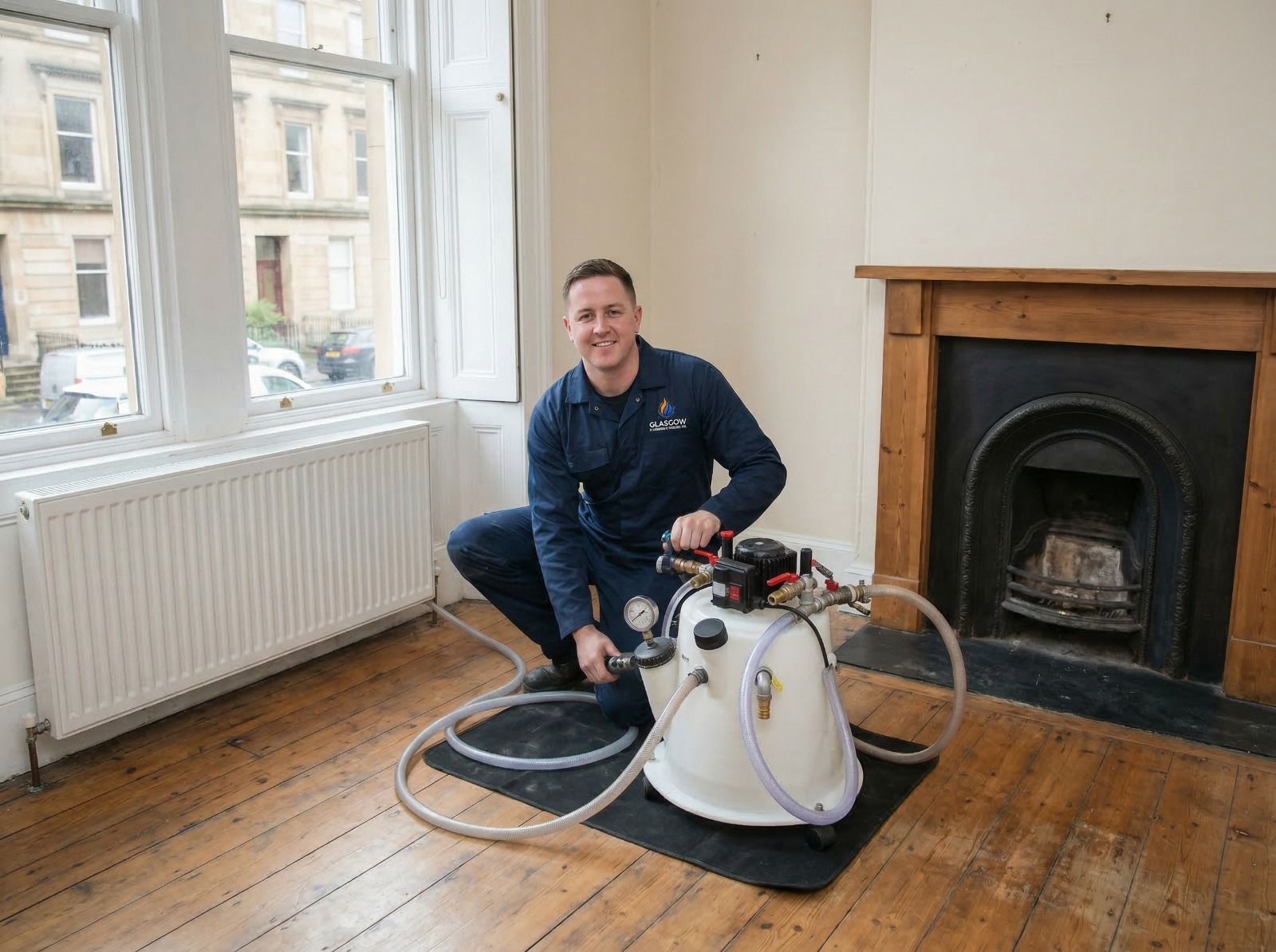
A professional power flush is not a chemical drain-and-refill. It uses a dedicated machine — in our case, a Kamco unit, the industry-standard equipment for central heating power flushing — to force water and cleaning chemicals through the system at high velocity and low pressure, dislodging and expelling sludge that chemical treatment alone cannot remove.
Step 1 — System Assessment
Our engineer arrives and checks the system. We use a thermal imaging camera to map cold spots across every radiator, giving us a clear picture of where blockages are worst before we start.
Step 2 — Machine Connection
The Kamco power flush machine is connected to the central heating circuit — typically at the pump position or a convenient radiator connection point. The system does not need to be drained first.
Step 3 — Chemical Treatment
We add a specialist descaling and sludge-dispersant chemical to the system. The machine circulates this at high velocity, breaking down compacted sludge deposits and limescale that have built up in radiators, pipework and the boiler heat exchanger.
Step 4 — Radiator-by-Radiator Flushing
We work through each radiator individually, isolating and flushing each one in turn and directing contaminated water out of the system via the machine's dump valve. Radiators that are more severely affected receive additional flushing time.
Step 5 — Magnetic Filter Service
Once the discharge water runs clean, we clean and refit the existing magnetic filter (or fit a new one if not already installed). The magnetic filter captures any residual fine particles that the flush has liberated, preventing them from recirculating.
Step 6 — Inhibitor and Recommission
We add fresh corrosion inhibitor to the clean system to prevent future sludge formation, refill and pressurise the system, and carry out a full balance check to confirm all radiators are heating evenly.
Step 7 — Certificate
Before leaving, we issue a power flush completion certificate recording the chemicals used, system condition and date — which you may need for future boiler warranty purposes.
Serving Your Neighbourhood
We keep our vans stocked with high-quality brassware and common parts to ensure first-time fixes in
Not sure if we cover your area? Just ask—we travel throughout Central Scotland for the right projects.
Glasgow North & West:
Bearsden, Milngavie, Bishopbriggs, Drumchapel, Clydebank
Glasgow East End:
Dennistoun, Parkhead, Tollcross, Easterhouse, Baillieston, Mount Vernon
Glasgow South:
Shawlands, Giffnock, Newton Mearns, Clarkston, Cathcart
Central Belt:
Stirling, Falkirk, Cumbernauld, East Kilbride, Motherwell
Power Flushing Glasgow — FAQs
How much does a power flush cost in Glasgow?"
Glasgow Plumbers & Boilers prices power flushing based on the number of radiators in your property, starting from £[PRICE]+VAT for smaller systems. All prices include thermal imaging assessment, Kamco machine flush, chemical treatment, magnetic filter service, inhibitor top-up and a completion certificate. We provide a free fixed-price quote — usually over the phone — before any work is booked
How do I know if I need a power flush?
The clearest signs are cold spots on your radiators — particularly at the bottom — black or discoloured water when you bleed a radiator, a boiler that makes a kettling or rumbling noise, radiators that are slow to heat up, and boiler lockouts that recur without an obvious fault. Any one of these symptoms indicates sludge contamination in your central heating system.
How do I know if I need a power flush?
The clearest signs are cold spots on your radiators — particularly at the bottom — black or discoloured water when you bleed a radiator, a boiler that makes a kettling or rumbling noise, radiators that are slow to heat up, and boiler lockouts that recur without an obvious fault. Any one of these symptoms indicates sludge contamination in your central heating system.
How long does a power flush take?
A full central heating power flush for a typical 3-bedroom Glasgow property with 8 to 10 radiators takes 4 to 6 hours. Smaller properties can be completed in 3 to 4 hours. Larger properties or severely contaminated systems may require a full working day. Someone must be present throughout the visit.
Will a power flush fix my cold radiators?
In the vast majority of cases, yes. Cold spots at the bottom of radiators are caused by settled sludge blocking hot water flow — this is precisely what a power flush is designed to address. The exception is a radiator with a mechanical fault such as a stuck valve, which would need a separate repair. Our engineers assess each radiator during the visit and confirm the cause before beginning the flush.
Do I need a power flush before installing a new boiler?
Yes — and most boiler manufacturers require it. Worcester Bosch and Vaillant both require evidence of a system flush as a condition of the extended manufacturer warranty. Installing a new boiler into a sludge-contaminated system risks immediate heat exchanger damage and can void the warranty from day one. A system flush is included as standard in every Glasgow Plumbers & Boilers boiler installation.
What areas do you serve?
- We are based in Glasgow and serve homeowners across the entire Central Belt.
- Our standard service radius extends 25 miles from the city center.
- This includes primary hubs such as East Kilbride, Stirling, Falkirk, Dumbarton, Kilmarnock, and Cumbernauld.
- We also provide hyper-local service to Glasgow suburbs including Bearsden, Shawlands, Newton Mearns, Bishopbriggs, and Dennistoun
- We are based in Glasgow and serve homeowners across the entire Central Belt.
Thank you for contacting us.
We’ll get back to you as soon as possible.